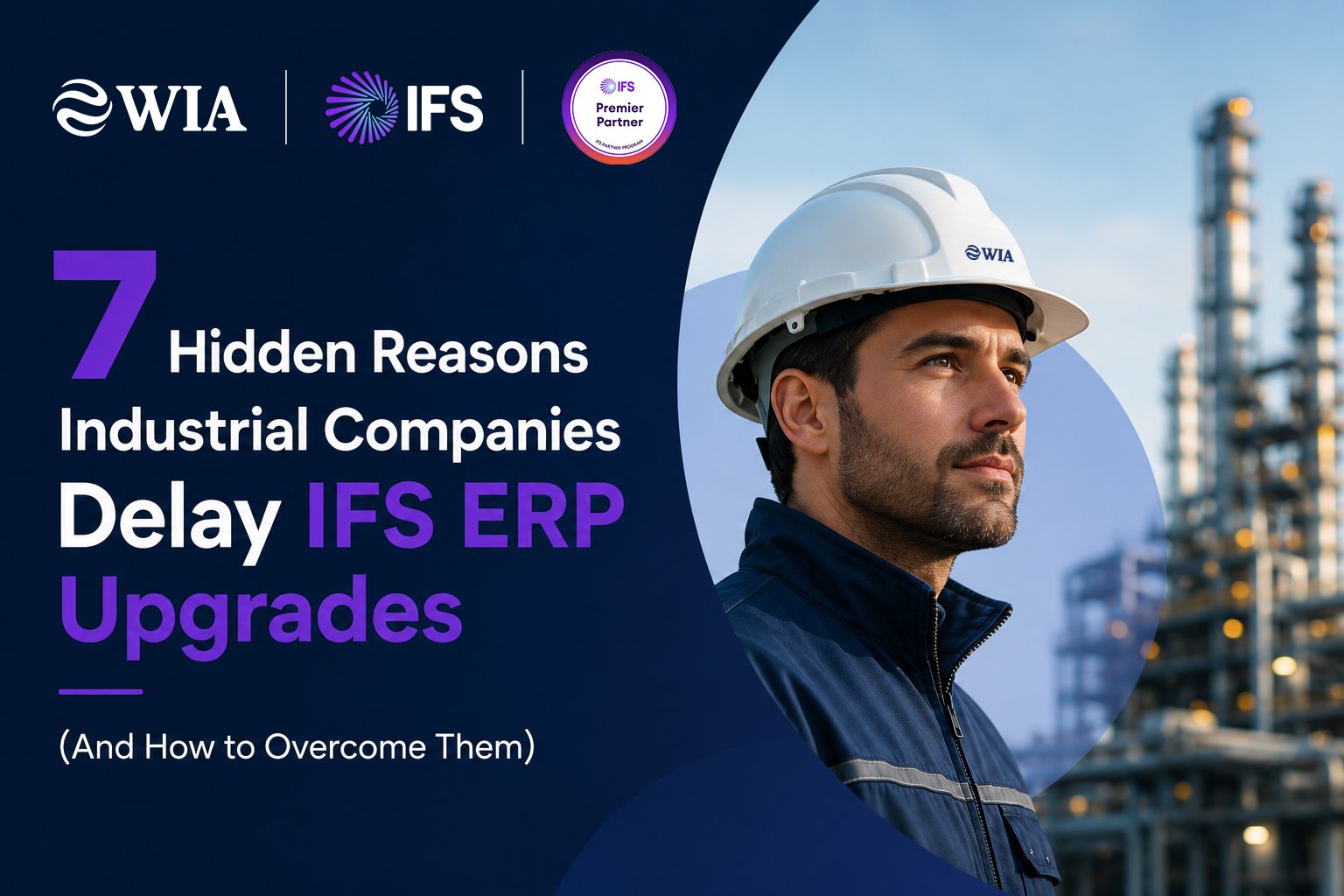
7 Hidden Reasons Industrial Companies Delay IFS ERP Upgrades (And How to Overcome Them)
"Should we upgrade our IFS ERP now or wait another year?" It's asked in boardrooms across manufacturing, engineering, and industrial businesses. Delaying feels safer, but it's usually the opposite; legacy systems drive up maintenance costs, limit scalability, create security risk, and make the eventual upgrade harder.
The real challenge isn't whether to upgrade; it's how to do it without disrupting the business. With the right planning and partner, that risk is well understood and manageable.
1. Fear of Operational Disruption
Uninterrupted operations are non-negotiable when production schedules and customer commitments are on the line. Most disruption don't come from the upgrade itself; it comes from inadequate planning, rushed testing, or unclear ownership of what happens if something breaks. For many organizations, that fear is rooted in a past project where a routine change turned into weeks of firefighting.
2. Complex Customizations
Years of custom development often become embedded in core processes, and nobody's entirely sure which parts still earn their keep. Over time, ownership of that knowledge fades, the people who built the customizations move on, and what's left is a system nobody wants to touch for fear of breaking something business-critical.
3. Budget and ROI Uncertainty
Upgrades tend to be judged on one large, uncertain number; but that's only half the picture. The other half, rising support costs on an aging version, workarounds staff have built around missing features, security exposure on unsupported releases rarely makes it into the business case, which skews the comparison toward staying put.
4. Data Migration Challenges
Many businesses discover that data, not software, is the real obstacle: duplicate records, inconsistent master data, and outdated information complicate migration and skew reporting if left unaddressed. The scale of the problem is often invisible until the upgrade forces it into the open.
5. Change Management Gaps
Technology projects rarely fail because of the software, they fail because people weren't brought along. Even when the workforce already knows the underlying system, resistance to what's different can quietly stall adoption long after the technical work is finished
6. Limited Internal Resources
Most industrial organizations don't have spare capacity sitting around, and asking the existing team to run an upgrade on top of the business usually means one of the two suffers; either the project slips or day-to-day operations take the hit.
7. Concerns About Go-Live Support
The anxiety here isn't go-live day, it's the days after, when issues surface under real usage and the team that built the solution isn't always the team left to support it.
We understand how disruptive these challenges can be to your operations and we also know none of them are unsolvable. They're simply the reasons the upgrade decision so often stalls.
Choosing the Right Partner: Why WIA Systems Is Built Differently for Upgrades
An upgrade isn't the same as an implementation. Implementation is about building something new; an upgrade is about protecting what already works while moving forward safely and that distinction shapes how WIA approaches every upgrade engagement.
- Deep IFS specialization.
As an
IFS Premier Partner,
WIA's consultants live inside the IFS ecosystem. On an upgrade, the risk isn't learning a new system, it’s knowing precisely what changes between versions and what doesn't.
- A rationalization mindset, not a rebuild mindset.
Rather than carrying every legacy customization forward by default, WIA leans on standard IFS functionality wherever possible.
- Support that doesn't end at go-live.
WIA's 24/7 global support model means the go-live support gap is covered by design, not scrambled together afterward.
- Resourcing without straining your team. A global delivery footprint lets WIA staff the project with dedicated specialists, freeing your team to keep running the business.
- Ongoing readiness through Application Management Services. IFS Cloud releases updates on a biannual cycle, and WIA's AMS keeps clients current between them so the next upgrade is a manageable step, not a five-year leap.
The upgrade decision doesn't have to be the hard part. With the right partner absorbing the risk, the disruption, and the resourcing gap, it becomes a managed process not a leap of faith.


Is Your Business Ready for the Next Step?
Let's assess your current ERP environment and identify the best path toward a successful IFS upgrade